

At Papilio, our designers and cabinet makers enjoy using veneers to create bespoke kitchens for our clients. Interestingly, it’s a general misconception that designer kitchens are made entirely from solid wood. Most, if not all, luxury kitchens made to clients’ specifications are finished with natural or engineered veneers. Solid wood kitchens do not perform as well and will not last because wood changes with time and use, changes its character, expands, and contracts, which can become problematic if you want the kitchen to last.
Differences Between Natural and Engineered Veneers
Natural veneers are a thin slice of solid timber. They are easier to produce and rather ingenious. Cut from wood such as oak, teak, or walnut, they take skill and a keen eye to select the most beautiful cuts. The grain, burrs, and imperfections on real wood veneers can make bespoke kitchens unique because no veneer is the same. Colour, notches, and knots all contribute to a finished cabinet’s overall look, creating as true a finish as possible.
Engineered veneers are more versatile and less temperamental in appearance. Often more costly because they are fabricated, engineered veneers can offer a fantastic, long-lasting finish. Materials vary widely and are often durable and highly functional.
The Art of Veneer Pattern Matching
Veneer pattern matching is the intentional, meticulous arrangement of individual wood slices to dictate how grain, texture, and light flow across the piece of furniture.
Veneer patterns matter in designer kitchens because they help to create visual flow and architecture. Luxury kitchens can feature expansive flat surfaces, tall units, integrated hidden doors, dynamic island faces, and long drawer runs. Without grain matching, adjacent cabinet doors look like disjointed, mismatched planks. Matched veneer ensures the wood’s natural narrative continues uninterrupted across every seam and reveal. From ‘crown cuts’ to ‘quarter sawn’, the designer and maker must either match or randomly place the grain so that the designer kitchen is fully considered.
Designer Kitchens Featuring Veneers
At Papilio, we work with natural and engineered veneers to create luxury kitchens with care and precision. Here are a few examples.
The North London Kitchen – Book-Matched ‘Crown Cut’ Veneer


Our North London Kitchen is a celebration of wood, stone and craftsmanship. Utilising oak and marble, we chose book-matched ‘crown cut’ pattern matching for the veneer elements of the designer kitchen. With feature oak as the highlight to the marble elements, the marriage of patterns demonstrates just how skilled our cabinetmakers are.
The Frome Kitchen – Random ‘Crown Cut’ Veneer

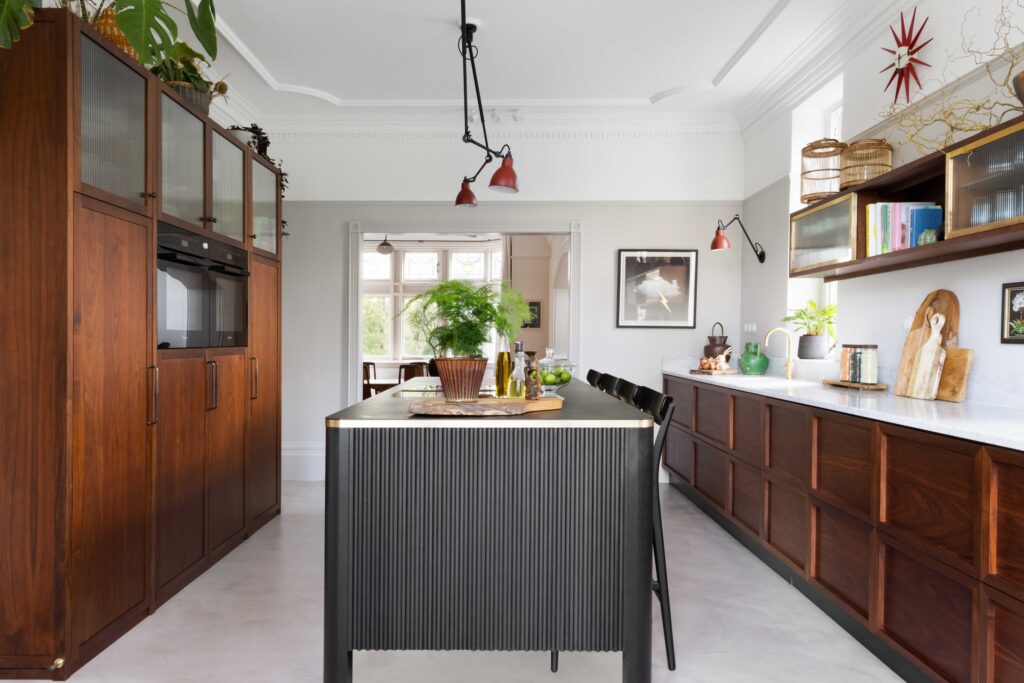
Our Frome Kitchen design drew inspiration from mid-century furniture, Scandinavian design, and the property’s architecture, with its distinctive Arts and Crafts detailing. The owners of the Edwardian Manor gave a carte blanche to overhaul the kitchen. The perimeter cabinets feature a red tint on the walnut, echoing the mid-century-style kitchen island constructed in Valchromat. For the veneer, we chose random ‘crown cut’ to add movement and aesthetic flow, contrasting with the linear wall cabinetry and fluted kitchen island.
The Scandinavian Kitchen – Slip-Matched ‘Quarter Sawn’ Veneer


The Scandinavian Kitchen is a fine example of a designer kitchen in the Victorian property featuring oak veneers. We selected straight lines of American oak veneer to complement the straight, but crossing lines in the parquet floor. Slip-matched, ‘quarter-sawn’, the flat-faced frontage of the cabinetry features simple yet beautifully engineered finger pulls. We topped the units with a cool marble surface and oversized backsplash, creating a fresh yet homely kitchen design.
